Send Money Across Africa: Why The Route Matters More Than The Fee
September 5, 2026financeThe hidden detour in a lot of "Africa to Africa" transfers
Say you're in Lagos and you need to send Naira to a supplier in Accra. That's a transfer between two African countries, so you'd assume it moves directly - Naira in, Cedis out. A lot of the time, it doesn't. Behind the scenes, plenty of providers convert your Naira into US dollars first, route the payment through a foreign bank, then convert those dollars into Cedis on the other end. Two currencies get pulled into a transfer that had nothing to do with either of them.
Who actually feels this
It's rarely a one-off problem. A trader in Kumasi paying a supplier in Lagos every month feels it every single time. So does a Kenyan family with one sibling working in Kampala and another back in Nairobi, splitting rent or school fees across two currencies. Diaspora communities who've moved between African countries for work - Ghanaians in Nigeria, Nigerians in South Africa, Kenyans in Uganda - run into this constantly, often without realizing the "fee" they're being charged isn't the full story.
Why that detour exists in the first place
It's not laziness on anyone's part - it's plumbing. Most global money transfer companies were built for a specific job: moving money from the US, UK, or Canada into Africa. Their infrastructure runs through correspondent banking relationships in major currencies like the dollar, because that's historically been the easiest way to settle payments when two countries don't have a direct relationship with each other. That works fine for a US-to-Nigeria transfer. It's a much clumsier fit for a Nigeria-to-Ghana one, where both ends are African currencies to begin with.
What the detour actually costs you
Every currency conversion carries a spread - the small gap between what a currency is genuinely worth and what you're quoted for it. One conversion means one spread. Two conversions means two, even if neither looks large by itself. Picture it this way: if converting Naira to Dollars quietly costs you half a percent, and converting those Dollars to Cedis costs another half a percent, you've lost roughly twice as much as a single, direct Naira-to-Cedi conversion would have cost - and that's before counting how long the extra bank-to-bank hops take, which is usually the real reason an "instant" transfer between two African cities somehow takes a day or two to land.
Where SendFP skips the detour
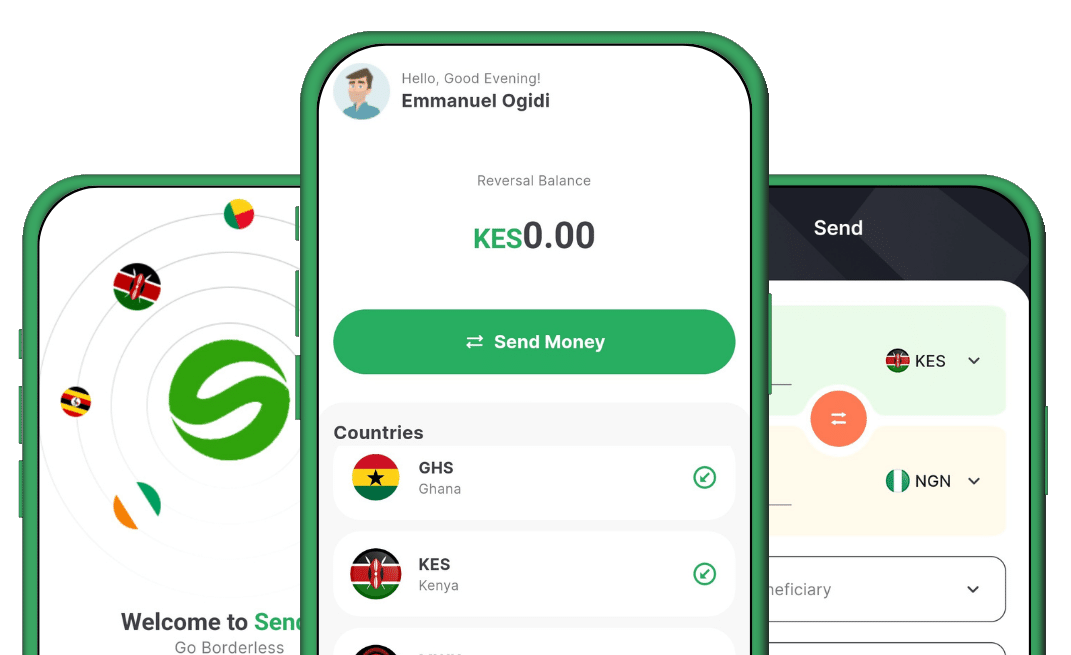
We support direct conversion between a growing list of African currency pairs, so your money doesn't have to pass through a currency neither you nor your recipient asked for. A few of the routes people use us for most:
- Naira to Cedi, for sending money to Ghana from Nigeria
- Naira to Kenyan Shilling
- Cedi to West African CFA Franc, for transfers into Francophone West Africa
- Kenyan Shilling to Ugandan Shilling
You can check any of these live, and see the exact rate before committing to anything, on our currency pages - NGN to GHS, NGN to KES, and KES to UGX among them. Most land in your recipient's bank account or mobile money wallet the same day, since we're not waiting on a chain of foreign banks to pass the payment along.
Bank account or mobile money - it shouldn't change the story
A lot of intra-Africa transfers end up in a mobile money wallet rather than a bank account, and that's a detail worth paying attention to. Mobile money is often the faster, more reliable way for a recipient to actually access funds, especially outside major cities - but not every provider handles wallet delivery as cleanly as they handle a bank deposit. Before you send, it's worth confirming your provider supports the specific wallet your recipient uses, and that the rate you're quoted doesn't quietly change depending on whether the money's headed to a bank or a phone number.
What to check before you send anything across the continent
- Ask whether the transfer converts directly between the two currencies, or bounces through a third one first.
- Compare the total amount your recipient actually gets, not just the advertised fee - a "free" transfer with a poor rate can cost more than a fee'd transfer with a fair one.
- If speed matters, ask what "instant" really means for that specific corridor. It varies more between country pairs than most people expect, and it usually comes down to whether the provider has a direct relationship in both countries or is routing through somewhere else.
The bottom line
Moving money between two African countries shouldn't require your Naira to become dollars and back again before it becomes Cedis. Check the direct rate, ask where your money is actually being routed, and you'll usually save more that way than you ever will chasing the lowest advertised fee.